
First Week in a Multi-Coin Pool: Setup, Shares and Credits
The first week of pool mining is mostly paperwork followed by a lot of waiting. A 437 TH/s machine pointed at the 21 September 2026 network conditions credits 0.00019604 BTC a day, or $16.60 gross and $15.94 after the listed 4%. The setup that produces those numbers takes an evening; understanding them takes a week of watching.
Key takeaways
- 437 TH/s earns 0.00019604 BTC a day, which splits into 24 credits of about 0.00000817 BTC under PPS+.
- Three fields decide where money goes: coin, wallet address and worker name; get them right before the first share.
- A seven-day run at this hashrate credits 0.00137228 BTC, or $116.20, if nothing stops.
- PPLNS pays after six confirmations instead of hourly, so the first credit can be a day or more away.
Three fields that decide everything
The coin comes first, because a pool account is usually organized around it. Pick the chain your hardware mines, then create a worker for each machine or group of machines. The worker name is bookkeeping, not security: it lets you see one rig's share rate separately from the rest, which matters the first time a fan fails and output drops by a third. Give it a name you will still understand in six months, such as the room and the rack position.
The payout address is the field that actually holds the money, so check it twice and then check it again from a second device. A wrong character sends the credit to an address nobody controls, and no support desk can reverse it. Address formats differ by chain, and a wallet that displays one chain's address may happily accept a paste from another. Start with a small test amount if the interface allows it, then confirm the arrival before pointing serious hashrate at the account.
Then choose the payout scheme. PPS+ is the default: the block-reward component settles hourly against current difficulty, with a listed 4% on that component and 2% on the transaction-fee portion. PPLNS combines the two components under a listed 2% rate and pays once a block reaches six confirmations, using your share of the pool over the last five difficulty rounds. The first scheme is steadier, the second fluctuates more and usually averages a little higher over long periods.
What happens to a share after you submit it
A share is a proof of work that is easier than a block. Your machine finds thousands of them a day, each one evidence that it performed a slice of hashing at the current difficulty. The pool counts them, compares the total against the network target, and pays according to the scheme you chose. Nothing about the process requires you to find a block yourself, which is the entire point of joining a pool: the variance moves from your machine to a much larger sample.
Share difficulty is worth understanding because it explains most dashboard confusion. When the pool raises the share difficulty for a fast miner, the number of accepted shares falls while the credited work stays the same. A miner who watches share counts instead of hashrate will think something broke. Watch the reported hashrate and the credits, and treat share counts as a diagnostic rather than a score.
The written ViaBTC Mining Guide covers the connection details for each supported chain, and its screenshots are more reliable than a forum post from three years ago. Read the page for your coin before changing anything in the miner's configuration, particularly the pool URL and the worker naming convention.
Day one to day seven at 437 TH/s
The table assumes a clean week: no downtime, no rejected shares, difficulty and price unchanged. Real weeks are messier, but the clean version gives you a baseline to compare against.
| Day | Hours of uptime | BTC credited | USD at $84,692 |
|---|---|---|---|
| 1 | 24 | 0.00019604 | $16.60 |
| 3 | 72 | 0.00058812 | $49.80 |
| 5 | 120 | 0.00098020 | $83.00 |
| 7 | 168 | 0.00137228 | $116.20 |
Compare the day-one credit with the pool dashboard rather than with the table. If the dashboard shows 0.00019 BTC after a full day, the setup is working. If it shows 0.00009, either the machine ran half a day or it is hashing at half the rated speed, and those two causes call for very different responses.
Worked example
- Network emission: 450 BTC a day, from 3.125 BTC across 144 blocks.
- Divide by the 1,003,000,000 TH/s of network hashrate: 0.0000004486 BTC for each TH.
- 437 TH/s: 437 × 0.0000004486 = 0.00019604 BTC.
- In dollars: 0.00019604 × 84,692 = $16.60.
- After the listed 4%: 16.60 × 0.96 = $15.94.
- Hourly under PPS+: 0.00019604 ÷ 24 = 0.00000817 BTC, about 69 cents.
- Seven days: 7 × 0.00019604 = 0.00137228 BTC, or 7 × 15.94 = $111.58 net.
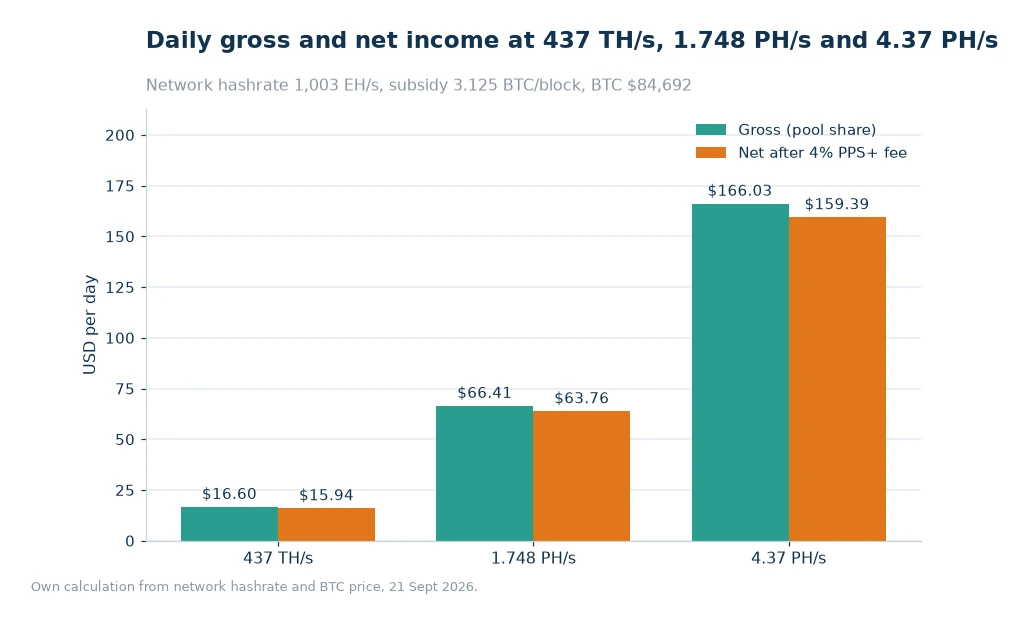
- 1.748 PH/s is 1,748 TH/s: 1,748 × 0.0000004486 = 0.00078415 BTC, or $66.41 gross and $63.76 net. At 4.37 PH/s, 4,370 × 0.0000004486 = 0.00196041 BTC, or $166.03 gross and $159.39 net.
The table counts gross credits: 0.00137228 BTC over seven days, or $116.20. The net version of the same week is $111.58, because each day loses the listed 4% on the block-reward component. Keep gross and net in separate columns, or a spreadsheet will quietly add them together.
Where the first week usually goes wrong
The most common failure is a miner that connects, submits shares for twenty minutes and then idles because the firmware lost the pool after a difficulty change. The dashboard shows a flat line and the credits stop; nobody notices until the monthly total looks short. Set an alert on the worker's hashrate, not on the account total, because the account total hides one dead machine among nine healthy ones.
The second failure is thermal. A machine pushed to its highest frequency in a cool room will throttle when the afternoon warms up, and the loss is gradual enough to escape a glance at the dashboard. Compare the reported hashrate at noon with the figure at midnight for three days. A repeatable dip is a cooling problem, and fixing airflow usually returns more coin than any firmware tweak.
The third is expectation. A miner who chose PPLNS and checks the balance every two hours will see nothing for a while and conclude the pool is broken. Under that scheme credits arrive after six confirmations, and the amount depends on how your shares fall inside the last five difficulty rounds. Watching it hourly is a recipe for unnecessary worry.
Reading the account after seven days
By day seven you should have two comparable numbers: what the arithmetic predicted and what the pool credited. Put them side by side and attribute the gap. Downtime explains small shortfalls; a persistent 10% gap suggests the effective hashrate is lower than the nameplate figure, which is common on older machines in warm rooms. A surplus usually means the price or difficulty moved in your favor, not that the machine is special.
Keep the first week's numbers. They become the baseline for every later change — a new firmware, a different coin, a second machine. Without a baseline, an improvement is indistinguishable from a lucky difficulty dip. With one, you can tell within a few days whether a change helped. When the balance is worth moving, the multi-currency wallet holds it inside the same account as the mining dashboard, so the payout address and the funds stay together.
Frequently asked questions
How long before the first payout arrives?
Under PPS+ the block-reward component settles hourly, so the first credit can appear within an hour of steady shares. Under PPLNS nothing arrives until a block reaches six confirmations, which can take a day or more.
Can I change the payout address later?
Usually yes, but the change applies to future credits only. Anything already sent to the old address stays there, which is why the address deserves a careful check before the machine starts.
Does a higher share count mean more income?
Not directly. Share difficulty can be raised for a fast miner, which lowers the count while leaving the credited work unchanged. Hashrate and credited BTC are the numbers that track income.
Point one machine at the pool and watch
Resist adding a second rig until the first has run a full week and you can explain every line of its credit history. The ViaBTC App for iOS and Android puts the hashrate curve and alerts on the same phone you carry, which makes the watching less of a chore. Setup is a one-evening job; the understanding is what compounds.
Sources: ViaBTC's homepage, pricing page and app page, covering connection steps, payout schemes and the listed 4% and 2% rates[1]. Inputs read 21 Sept 2026 — BTC $84,692; 1,003 EH/s of network hashrate; 132.76 T difficulty; 450 BTC minted per day from 3.125 coins across 144 blocks. Credits assume the machines never stop. Published 22 Oct 2026.